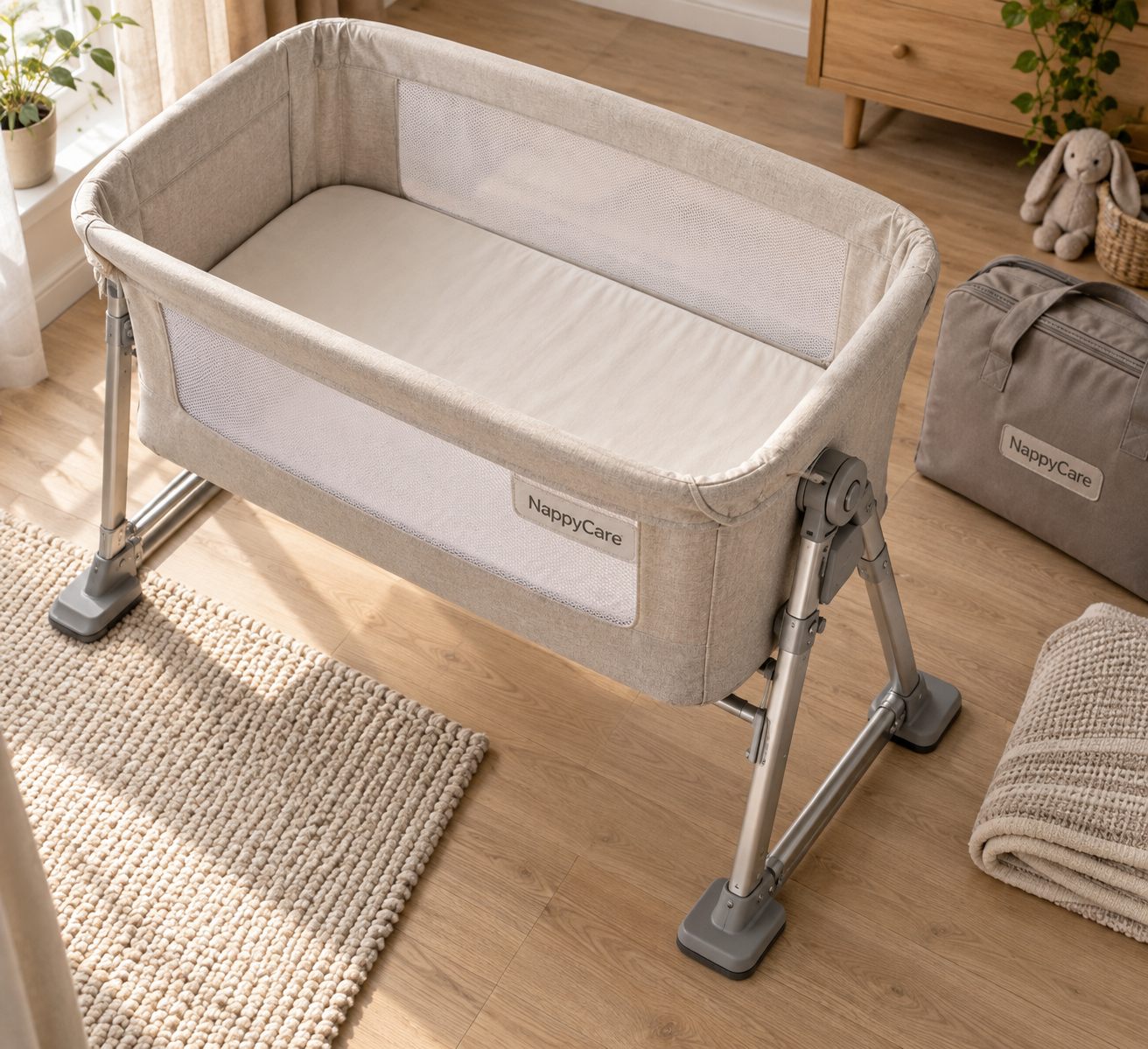
6 months is the American Academy of Pediatrics’ ideal room-sharing minimum, not a bassinet-use deadline. A baby bassinet is a compact, separate infant sleep space, but how long it suits your family depends on the model’s limits and your room. Compare safety and fit before paying for motion, storage, or stylish extras.
Check U.S. safety compliance before comparing extras.
Use only the mattress pad and fitted sheet made for the model.
Measure the room and adult bed before ordering.
Lock wheels and follow the manual’s setup instructions.
Stop use at the model’s weight or developmental limit.
A safe crib may make a bassinet unnecessary.
1. Sleep Surface and U.S. Safety Compliance Come First
The bassinet’s sleep surface matters more than its finish or features. It should be firm, flat, and level, with no added padding. In the United States, bassinets and cradles must meet federal requirements in CPSC regulation 16 CFR Part 1218. Start by checking the exact model, not just the brand name.
Confirm the model and standard
Look for the manufacturer’s statement that the specific bassinet complies with the U.S. standard, and read its manual before buying. A broad product description such as “safety tested” doesn’t tell you whether the model meets the required standard or what setup it allows.
The manual explains which mattress pad and sheets fit, how to assemble the frame, and which modes are intended for sleep. Keep those instructions after setup. A replacement part that looks similar may not fit securely or may not be approved for that model.
The American Academy of Pediatrics recommends room-sharing, ideally for at least the first 6 months.
That recommendation means the baby sleeps in the parents’ room on a separate surface. It doesn’t mean the baby must use a bassinet until six months, or that a bassinet can attach to every adult bed.
Keep the surface bare and compatible
For every sleep, place your baby on their back on the bassinet’s firm, level surface. Use only the fitted sheet made for that model. Don’t add a topper, pillow, blanket, mattress, or rolled towel to fill a gap or make the surface softer.
Check that the pad lies flat and fits its intended space without bunching. If a sheet is hard to find, confirm the manufacturer’s approved replacement before purchase. A generic sheet that pulls loose or leaves extra fabric can create a hazard, even if its dimensions seem close.
2. Dimensions and Bedside Fit Need a Room Check
A bassinet can fit beside the bed and still block a doorway, drawer, or nighttime walking route. Check the full base footprint, including legs and wheels, rather than judging from the sleeping area alone. The room needs enough space for the unit to sit level and for caregivers to reach it safely.
Measure the room and the route
Measure the spot where you plan to use the bassinet, then compare it with the manufacturer’s listed dimensions. Also check the path from the entryway to that spot. A compact sleeping area can sit on a wider base, and folded dimensions may differ from the assembled size.
Consider what happens after setup. If the bassinet will be moved between rooms, check the width of the tightest doorway and whether the assembled unit can pass through it. Don’t assume a model with wheels is designed to move while occupied; follow its manual.
Bassinet type
May suit
Check before buying
Stationary bassinet
One regular sleep location
Base footprint and access around it
Bedside sleeper
Placement beside an adult bed
Approved bed-height range and attachment method
Foldable or travel model
Moving or storing the unit
Sleep-use instructions, locks, and setup steps
Rocking model
Families who want a motion feature
Approved sleep mode and stability on the floor
Treat bedside placement as model-specific
A bassinet is not automatically a bedside sleeper. Only a model designed for bedside use should attach to an adult bed, and its manual will specify how to secure it and which bed heights it fits. Don’t lower a side, remove a rail, or improvise straps on a standard bassinet.
Even when a model sits next to the bed, the baby’s surface stays separate from the adult mattress. Follow the instructions for required clearance and attachment. If the bed frame or mattress prevents a secure fit, use the bassinet in its approved standalone mode or choose another sleep space.
3. Portability Is Useful Only With Stability
Portability can make a bassinet easier to store or move between rooms, but it doesn’t make the unit safer. A lighter frame may be convenient to carry, while a wheeled base may be easier to reposition. Either way, the bassinet needs to stay stable on a level floor during sleep.
Check wheels and folding hardware
If the model has wheels, check that its locks work and that you can reach them after setup. Engage the locks for sleep when the manual directs you to do so. Don’t place the bassinet on a raised surface to keep it closer to the bed unless the manufacturer specifically designed it for that use.
For a folding bassinet, practice opening and closing it before the first night. Confirm that every latch engages and the frame is fully locked. A half-latched frame can shift under pressure. If the bassinet will be moved often, choose a design you can fold and carry without skipping steps.
Treat rocking as an extra
Rocking or powered motion is a convenience feature, not a substitute for a stable, approved sleep surface. Check whether the manufacturer permits sleep while the motion feature is running and whether the model has a stationary setting. Don’t improvise by rocking a standard bassinet or blocking its frame with household items.
Look at how the base behaves on the floor when the unit is assembled. It should not wobble, slide, or tip during ordinary use. Follow the manual for locking the frame or motion mechanism. If a feature makes the unit harder to secure or operate correctly, choose a simpler model.
4. Height Adjustment Should Make Care Easier, Not Change the Sleep Setup
Adjustable height can bring a bassinet closer to the adult bed, but it doesn’t turn the bed and bassinet into one surface. Check the manufacturer’s height range against your actual bed setup. A setting that looks level in a product photo may not work with your mattress, frame, or foundation.
Measure the mattress-top height
Measure from the floor to the top of your made bed, including the mattress and any foundation. Compare that measurement with the model’s approved height range. For a bedside sleeper, also check whether the attachment points work with your bed frame and mattress thickness.
Once attached, follow the manual to confirm the sleeper is secure and there’s no unsafe gap between the two surfaces. If the bed is outside the stated range, don’t raise the bassinet with blocks or try to bridge the gap with bedding. Use a separate approved setup instead.
Check everyday access and sheet fit
Think through nighttime care: Can you reach the baby without leaning over an unstable rail? Can you get to the bassinet without stepping around cords or furniture? A height setting that improves access is useful only if it remains within the manufacturer’s instructions.
Check how the mattress pad and matching fitted sheet are cleaned and replaced. Some models use a specific sheet shape, so confirm approved options before buying. Don’t stretch a sheet over an unfamiliar pad or add another mattress to compensate for a loose fit. If the approved sheet is unavailable, pick a model with replacement bedding you can obtain.
5. Follow the Model’s Limits and Check for Recalls
There is no single age that ends bassinet use for every baby. Follow the manual’s weight limit and developmental stop-use rules. Some models have more than one limit, so use the earliest limit listed rather than waiting for a particular age or relying on how much room the baby seems to have.
Use the manual’s stop-use rule
Instructions may tell you to stop when the baby reaches a stated weight or begins a particular movement, such as pushing up on hands and knees. The exact criteria vary by model. A baby who is still below the weight limit may still have reached a developmental limit.
Read the full warning label before the first use, then check it again as your baby grows. If your baby reaches any stop-use condition listed for the bassinet, move to an appropriate sleep space. Don’t keep using it because the baby hasn’t reached a common age range.
Check the exact model and prepare the next sleep space
Before buying new or used, find the model number on the product label and search CPSC recall notices for that exact model. For a secondhand bassinet, also check that you have the manual and all original parts, and that the frame, locks, fabric, and sleep pad are in good condition.
Find the product’s exact model name and number.
Search CPSC recall notices for that model.
Confirm you have the manual and required parts.
Inspect the frame, locks, fabric, and sleep surface for damage.
Verify the weight and developmental limits before use.
Set up the next sleep space before the bassinet reaches a limit. A compliant crib in the same room can support room-sharing without extending bassinet use past its instructions. The AAP’s six-month room-sharing recommendation is about the room arrangement, not the age a baby must leave a bassinet.
6. Bassinet or Crib? Check the Short-Term Value
If a safe crib already fits your bedroom and nighttime routine, you may not need a bassinet. Both can provide a separate infant sleep space when the specific product meets U.S. requirements and is used as directed. The choice depends on space, access, and how you plan to use the room.
A bassinet may make sense when its smaller footprint or bedside setup solves a specific problem. Its drawback is its limited use period: your baby may outgrow its weight or developmental limits before you expect. Don’t pay extra for features you won’t use during that time.
A crib can be the more practical choice if it fits near your bed and caregivers can reach it comfortably. It takes more room, and not every bedroom layout can accommodate one beside the bed. Check the crib’s instructions and safety requirements just as carefully as you would for a bassinet.
For a straightforward value check, divide the full purchase cost by the months you realistically expect to use the bassinet. Don’t assume use will last six months; your baby may reach the model’s limit earlier. Include only approved accessories you’ll need, such as a fitted sheet made for that product.
Before you buy, write down the bassinet’s model, footprint, approved bed-height range, and stop-use limits. If a safe crib already fits your room and care routine, skip the short-term purchase. If it doesn’t, choose the simplest bassinet that meets the safety standard and fits your space.
Frequently Asked Questions
How long can a baby use a bassinet?
Use it only until your baby reaches the first weight or developmental limit in the manufacturer’s instructions. Age alone isn’t a reliable guide because babies reach movement milestones at different times and products have different limits.
Can a bassinet sit right next to an adult bed?
Only attach a bassinet to an adult bed if that exact model is designed for bedside use and installed as directed. Otherwise, use it as a separate standalone sleep space and don’t lower a side or bridge a gap yourself.
Can a baby sleep overnight in a stroller bassinet?
Only use a stroller bassinet for sleep if its manufacturer explicitly approves that use and provides instructions for it. A stroller attachment isn’t automatically a suitable overnight sleep space, even when it looks like a traditional bassinet.
Do I need to buy an extra mattress for a bassinet?
No. Use the mattress pad supplied or approved for that model, without adding a topper or second mattress. If the original pad is damaged, get the manufacturer’s approved replacement rather than substituting one that appears to fit.