
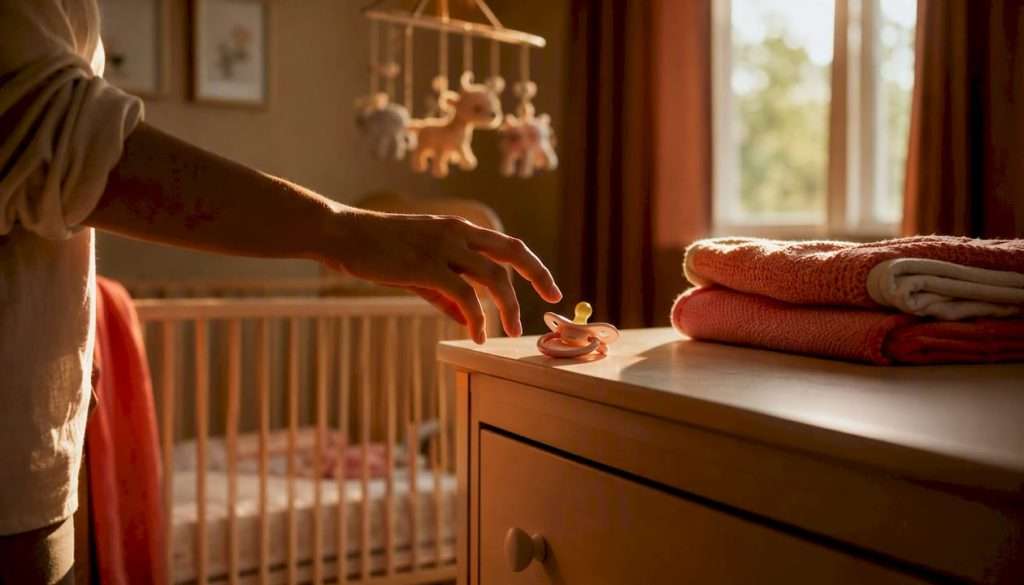
The best window to start weaning your baby off a pacifier is between 6 and 12 months, and the method most families succeed with first is gradual, sleep-first reduction: limit the pacifier to naps and bedtime before gradually removing it at other times. This approach protects the SIDS-reduction benefits tied to early pacifier use while getting ahead of the ear infection and dental risks that build up the longer the habit continues.
Three things you can try tonight, before you commit to a full plan:
- Pull the pacifier during awake, active play. If your baby isn’t reaching for it during stacking blocks or bath time, that’s an easy first win.
- Swap it for a small comfort object at bedtime. A soft blanket or plush toy in the crib gives your baby something else to hold while you phase out the pacifier itself.
- Praise every small success out loud. Toddlers respond to specific praise (“You put your paci down all by yourself!”) far more than they respond to being told no.
Pro Tip: Start the process on a week with no other big changes. Wean off pacifier the same week as starting daycare or moving to a big-kid bed stacks stress your child doesn’t need.
Key Takeaways To Wean Off Pacifier
Gradual, sleep-first weaning between 6 and 12 months, paired with a replacement comfort object, resolves the pacifier habit with the least sleep disruption and the strongest dental outcomes.
| Point | Details |
|---|---|
| Start early | Begin limiting daytime pacifier use between 6 and 12 months old. |
| Pick a 2 to 4 week plan | Use the gradual, sleep-first schedule rather than an unplanned cold-turkey attempt. |
| Choose a replacement | Introduce a comfort blanket or stuffed toy before removing the pacifier at bedtime. |
| Watch for red flags | Contact a pediatrician or dentist for speech delays, visible bite issues, or wakings lasting weeks. |
| Expect setbacks, use praise | A rough few nights is normal; verbal praise works better than punishment or bitter coatings. |
| Support the transition | Nappycare’s one-piece pacifiers and comfort accessories support each stage of the plan. |
This article is general information, not a substitute for advice from a qualified doctor. Consult a qualified healthcare professional about your own circumstances before acting on anything here.
Table of Contents For Wean Off Pacifier
- When to Start Weaning Off a Pacifier and Why It Matters
- What Are the Best Methods to Wean a Child Off a Pacifier?
- How Do You Wean Off a Pacifier in 2 to 4 Weeks?
- What to Do When Your Toddler Fights the Pacifier Weaning Plan
- Pacifier Safety, Cleaning, and When to Replace It
- When to Ask a Pediatrician, Dentist, or Sleep Consultant for Help
- What Do AAP, AAPD, and Mayo Clinic Say About Pacifier Weaning?
- Our Take: Why Sleep-First Weaning Beats a Rigid Calendar
- Practical Products That Support a Smoother Pacifier Transition
- Sources
When to Start Weaning Off a Pacifier and Why It Matters
Timing isn’t arbitrary here. The American Academy of Family Physicians notes that the protective effect against SIDS is concentrated in the first six months, which is exactly why pediatricians don’t recommend pulling the pacifier at birth. But once your baby passes the 6 month mark, the calculus flips: continued use starts adding risk for otitis media (ear infections) and, eventually, dental problems, without adding much further SIDS protection.
That’s the window worth understanding in three parts.
6 to 12 months is the sweet spot most clinical guidance points to. Your baby has moved past the highest-risk SIDS period, and daytime pacifier use hasn’t yet had time to affect jaw or tooth alignment. The Cleveland Clinic specifically recommends cutting daytime access by around 12 months, while allowing sleep-only use to continue a bit longer for families who need it.
12 to 24 months is when the dental picture starts to shift. Mayo Clinic is direct about this: harmful dental effects can begin by age 2, so weaning before that birthday helps prevent lasting changes to how teeth and jaw develop. Some pediatric dentists put the advisable window even earlier, suggesting 12 to 18 months as the point to start actively working on it.
Past 24 to 36 months is where the American Academy of Pediatric Dentistry draws its hard line. AAPD guidance calls for stopping nonnutritive sucking habits, pacifiers included, by 36 months at the latest, since prolonged use past that point meaningfully raises the risk of malocclusion (a bite that doesn’t line up correctly).
Pacifier use naturally drops off as children get older on its own, since most toddlers lose interest around the time verbal skills and other soothing routines take over. But “naturally drops off” and “gone by age 3” are two different things, and plenty of families need to actively intervene to close that gap.
| Point | Details |
|---|---|
| Ideal start window | Begin reducing pacifier use between 6 and 12 months old. |
| Daytime cutoff | Limit daytime pacifier use by around 12 months. |
| Dental risk threshold | Harmful dental effects may begin by the second birthday, per Mayo Clinic. |
| Absolute latest stop | AAPD recommends stopping by 36 months to avoid malocclusion. |
What Are the Best Methods to Wean a Child Off a Pacifier?
There’s no single right way to do this, and the method that works depends heavily on your child’s age, temperament, and how attached they are to the pacifier in the first place. Here’s how the main approaches stack up.
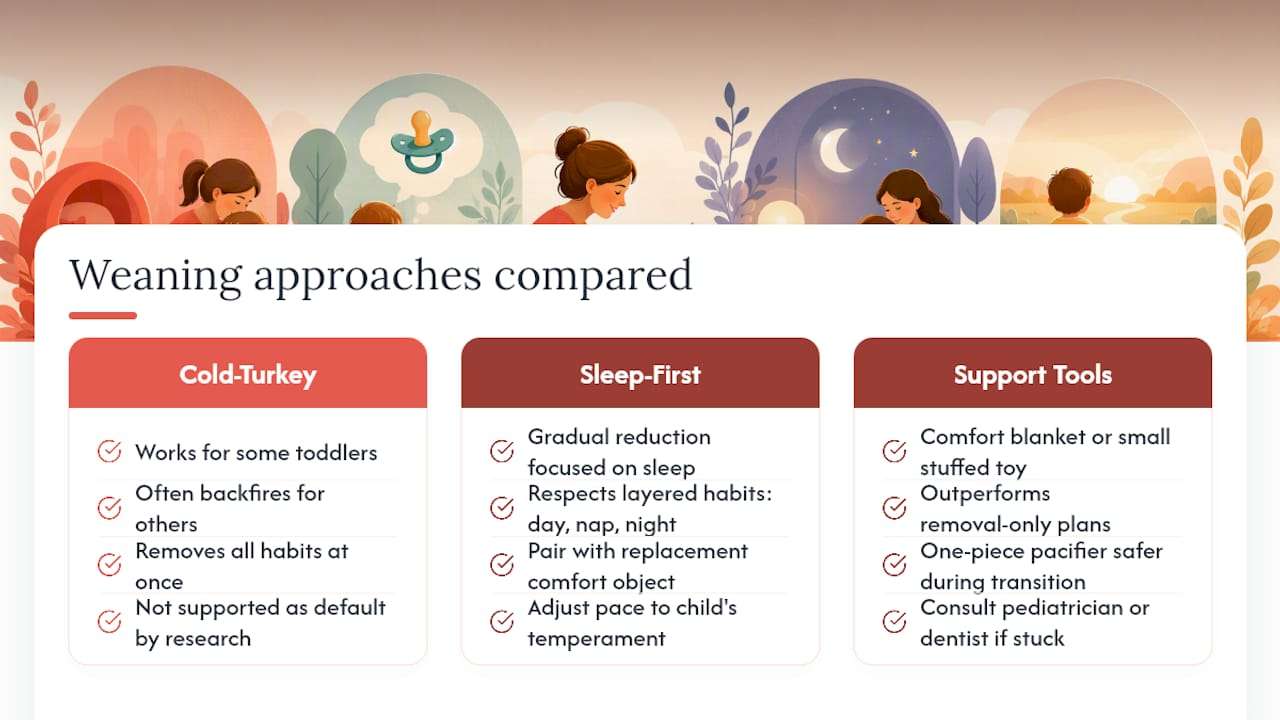
Gradual, sleep-first reduction limits the pacifier to naps and bedtime first, then removes it from sleep last. This suits younger toddlers (roughly 12 to 18 months) best, since it doesn’t require them to understand or agree to anything. It’s also the gentlest on sleep, since you’re not disrupting the one context where the pacifier does the most soothing work until the very end.

Cold turkey means removing the pacifier entirely, all at once. It works, and it works fast, sometimes in three to five rough days rather than three weeks. But it’s a harder few nights, with more crying and more night waking upfront, and it asks a lot of very young toddlers who don’t have the words to understand why their comfort object just vanished.
Story or ritual-based weaning (“giving the pacifier to a fairy,” “trading it in for a big-kid gift,” a “pacifier goodbye party”) works well for toddlers around 2 to 3 years old who understand symbolic exchange. Parent guides from Children’s Mercy point to trade-in rituals as one of the gentler transition points, since the child feels like an active participant rather than someone something is being taken from.
Trade-for-object weaning replaces the pacifier with a specific comfort item, a blanket, a small stuffed animal, before or during the removal process, so there’s always something to reach for.
Child-led weaning simply waits for natural disinterest and supports it when it appears, rather than forcing a timeline. It’s the lowest-conflict option, but it only works if that natural drop-off is actually happening before the dental-risk windows above close in.
| Method | Best for | Typical disruption |
|---|---|---|
| Gradual, sleep-first | Ages 12 to 18 months, or cautious first attempts | Low; spreads discomfort over 2 to 4 weeks |
| Cold turkey | Families wanting a fast, defined end date | High for 3 to 5 days, then resolves quickly |
| Story or ritual | Ages 2 to 3, verbal toddlers who grasp exchange | Moderate; softened by the toddler’s participation |
| Trade-for-object | Any age, paired with another method | Low to moderate; depends on the base method |
| Child-led | Toddlers already losing interest | Minimal, but slower and less predictable |
Pro Tip: If gradual reduction stalls after a week with no progress, that’s your signal to layer in a ritual. Combine methods rather than starting over. Keep the sleep-first schedule you’ve built and add a small goodbye ceremony for the final removal instead of abandoning the plan entirely.
How Do You Wean Off a Pacifier in 2 to 4 Weeks?
Here’s a plan built around the gradual, sleep-first approach, since it has the best track record for balancing dental and sleep priorities without a brutal first week.
- Week 1: Limit daytime use only. Keep the pacifier available only for naps and bedtime. During the day, if your toddler reaches for it, redirect with a toy, snack, or activity instead of handing it over. Say something like, “Paci is for sleepy time now. Want your bunny instead?”
- Week 2: Hold the daytime line, introduce the comfort object at bedtime. By now daytime requests should be dropping. Start layering in whatever replacement item you’ve chosen, a small blanket or plush toy, during the bedtime routine alongside the pacifier, so the association starts forming before you remove anything else.
- Week 3: Drop naptime. Offer the comfort object for naps instead of the pacifier, while keeping the pacifier at nighttime only. Expect one or two rough naps this week; that’s normal and not a sign the plan is failing.
- Week 4: Remove at bedtime. This is the final stage. Lean on the comfort object, a consistent routine (bath, book, song, lights out), and calm reassurance. For toddlers old enough to understand exchange, this is a good week to add a small ritual, like giving the pacifier to a stuffed “pacifier fairy.”
A few practical adjustments make this plan work for different kids:
- If your child only uses the pacifier to fall asleep (not throughout the day), you can likely skip straight to weeks 3 and 4 and move faster.
- If your child uses it constantly throughout the day, stretch week 1 to two full weeks before moving on. Rushing daytime removal is the most common reason gradual plans stall.
- Offer choices where you can: “Do you want to give paci to teddy, or put it in the box?” Choice-based language gives toddlers a sense of control that reduces power struggles.
| Point | Details |
|---|---|
| Week 1 goal | Remove pacifier during all waking hours, keep it for sleep only. |
| Week 2 goal | Introduce a replacement comfort object at bedtime alongside the pacifier. |
| Week 3 goal | Drop the pacifier at naptime, keep it only for nighttime sleep. |
| Week 4 goal | Remove the pacifier at bedtime, using ritual or story for older toddlers. |
What to Do When Your Toddler Fights the Pacifier Weaning Plan
Setbacks are close to universal, not a sign you picked the wrong method. Expect some combination of increased night waking, bedtime tantrums, or your toddler suddenly asking for the pacifier in situations where they hadn’t needed it in weeks, like a new daycare room or a visit to grandma’s house.
- Increased night waking in the first few nights: Stay consistent with your bedtime routine, but don’t reintroduce the pacifier once you’ve removed it for sleep. A brief regression of three to five nights is common and usually resolves on its own.
- Tantrums at nap or bedtime: Offer the comfort object and calm physical presence (a hand on the back, a few extra minutes sitting nearby), but hold the line on the pacifier itself. Comfort the child, not the habit.
- Asking for it in new or stressful situations: This is normal regression, not failure. A new environment naturally makes kids reach for old comforts. Redirect to the replacement object rather than reintroducing the pacifier.
The most useful distinction to hold onto is comfort versus reversal. You can absolutely offer extra hugs, extra patience, and a slower bedtime routine during a hard week without undoing the plan, as long as the pacifier itself stays off the table once you’ve moved past that stage. Clinical guidance consistently favors positive reinforcement over punishment, things like small charts, verbal praise, or a reward for a full pacifier-free nap, rather than scolding or shaming a toddler who’s struggling.
Pro Tip: Pair the final bedtime removal with a slightly earlier bedtime for a week. An overtired toddler has a much harder time self-soothing without the pacifier, so a little extra sleep buffer takes the edge off the hardest nights.
Pacifier Safety, Cleaning, and When to Replace It
While a pacifier is still in rotation, a few safety basics matter more than most parents realize.
- Choose a one-piece design with no separate parts that could break off and become a choking hazard.
- Check the shield size, it should be wider than your baby’s mouth and have ventilation holes so air can pass through if it presses against the face during sleep.
- Never attach a pacifier to a long strap, cord, or ribbon around your baby’s neck or crib, which creates a strangulation risk.
- Inspect regularly for tears, discoloration, or stickiness in the silicone, and replace immediately if you find any.
- Never dip a pacifier in sugar, honey, or juice to encourage use; this contributes directly to early tooth decay.
Cleaning rules genuinely change as your baby grows. Under 6 months, Mayo Clinic recommends sanitizing pacifiers regularly, boiling or running them through the dishwasher, since a young infant’s immune system hasn’t built up much defense yet. After 6 months, routine washing with soap and warm water is generally sufficient. One habit worth breaking regardless of age: never “clean” a dropped pacifier by rinsing it in your own mouth, since this transfers your own oral bacteria directly to your baby.
If you’re still using a pacifier during this transition, a well-made one-piece pacifier with the right nipple size for your baby’s age reduces the safety guesswork while you work through the weaning plan.
When to Ask a Pediatrician, Dentist, or Sleep Consultant for Help
Most families can manage weaning without professional support. But a few signals mean it’s worth reaching out rather than continuing to troubleshoot alone.
- Speech concerns: If persistent pacifier use is coinciding with delayed speech sounds or unclear articulation past the age you’d expect clearer speech, mention it to your pediatrician.
- Visible dental changes: A noticeably open bite, teeth that don’t meet correctly, or a jaw that looks misaligned warrants a pediatric dentist visit rather than a wait-and-see approach.
- Sleep disruption that won’t resolve: A few rough nights during active weaning is expected. Wakings that persist for several weeks after you’ve fully stopped the pacifier are a different story and worth a conversation with a sleep consultant or your pediatrician.
Match the concern to the right professional: a pediatrician for ear infections or general sleep and health questions, a pediatric dentist for anything bite or tooth-alignment related, and a certified sleep consultant if the sleep association has become deeply entrenched despite a consistent weaning plan. Before the appointment, jot down when the behavior started, how many nights per week it’s happening, and what you’ve already tried, that timeline makes the visit far more productive.
What Do AAP, AAPD, and Mayo Clinic Say About Pacifier Weaning?
The clinical consensus across major bodies is more aligned than most parenting forums suggest.
- SIDS-reduction benefits are concentrated in the first six months of life, which is why AAFP guidance recommends against pulling the pacifier too early, even while recommending weaning starts by the 6 to 12 month window.
- Otitis media (ear infection) risk rises with continued pacifier use past infancy, one of the key reasons the weaning window closes earlier than many parents expect.
- Dental malocclusion risk climbs the longer nonnutritive sucking continues past toddlerhood, with AAPD guidance setting 36 months as the outer limit.
- Pediatric dentists interviewed by health enews put the practical action window even earlier, around 12 to 18 months, for families wanting to get ahead of dental concerns rather than react to them.
No single source disagrees with another here so much as they emphasize different risks. Mayo Clinic’s dental focus pushes for action before age 2. AAPD’s bite-alignment focus draws a hard line at 36 months. The practical read for most families: start reducing between 6 and 12 months, treat 12 months as your daytime deadline, and treat 36 months as an absolute ceiling you don’t want to approach.
Our Take: Why Sleep-First Weaning Beats a Rigid Calendar
The advice families get most often, “just rip the bandage off,” works for some kids and backfires for others, and the research doesn’t actually support treating it as the default. A sleep-first, gradual approach respects something cold-turkey methods ignore: the pacifier isn’t one habit, it’s several habits layered on top of each other, daytime comfort, nap association, bedtime ritual, that happen to share one object. Removing all three at once is what causes the worst nights, not the pacifier itself.
What gets underestimated is how much the replacement matters more than the removal method. A toddler doesn’t need to stop needing comfort at bedtime; they need a different comfort object to reach for. That’s why pairing gradual reduction with something like a comfort blanket or small stuffed toy tends to outperform plans that just remove the pacifier and hope the child adjusts. And if a pacifier is still part of the routine during the early weeks of this process, a well-designed one-piece pacifier keeps that stage safer while you work through it.
There’s no version of this plan that fits every child on the same calendar. A toddler who only reaches for the pacifier at bedtime is a different project than one who carries it everywhere. Adjust the pace to your child’s temperament, hold the age windows as guardrails rather than deadlines, and loop in your pediatrician or dentist the moment something feels genuinely stuck rather than just slow.
Practical Products That Support a Smoother Pacifier Transition
You don’t need a cart full of gear to wean successfully, but a few thoughtful items make each stage of the plan easier. If your baby still needs a pacifier during the early weeks, a well-made one-piece pacifier with proper ventilation and no detachable parts keeps that stage as safe as possible while you work through the schedule.
For the replacement stage, a soft comfort blanket or small plush toy gives your toddler something new to bond with before the pacifier disappears entirely, which is often the single biggest factor in how smoothly bedtime goes during weeks two through four. If your child’s pacifier use is more about oral fixation than sleep soothing, a silicone teether can redirect that need during the day without reinforcing the same nighttime association you’re trying to break.
Nappycare carries all three categories with the same standard: safe, one-piece construction and materials built for daily handling by small hands. If you’re planning your weaning timeline this week, browse the baby accessories collection for a comfort object your toddler can start bonding with before you touch the bedtime routine at all.
Sources
- Pacifiers: Are they good for your baby? – Mayo Clinic
- Pacifiers: Common Questions and Answers | AFP
- When (and How) To Stop Pacifier Use – Cleveland Clinic
- Saying goodbye to the pacifier: A gentle guide for parents – Children’s Mercy
- How to smoothly wean your child off pacifiers | health enews