

You're standing in a dim nursery, one hand on the bassinet, the other tugging a tiny sleeve straight after a nappy change. The room feels cool, but not quite cold, and you're doing the familiar new-parent maths, too many layers or not enough, too snug or too loose, too warm for sleep or not warm enough for comfort. A newborn fleece onesie can feel like the answer in that moment, but the core question is simpler and more useful, how do you use fleece as part of a dressing system without guessing?
Table of Contents
- The Midnight Moment Every New Parent Recognises
- What a Newborn Fleece Onesie Is
- Fleece Compared With Cotton, Bamboo and Wool
- Getting the Size Right in the First Eight Weeks
- How Warm Fleece Really Is and When to Use It
- The Overheating Question Most Guides Skip
- Washing and Drying Fleece in NZ Conditions
- Your Newborn Fleece Onesie Buying Checklist
The Midnight Moment Every New Parent Recognises
At 2am, the logic changes. You're not shopping for a cute outfit, you're trying to solve a tiny weather problem on a sleepy, wriggly body while keeping the whole process calm enough that everyone can go back to sleep. In a New Zealand winter bedroom, that often means asking whether the layer you just chose is doing the right job, or whether it's doing too much.
A fleece one-piece looks reassuring because it feels warm in your hands. That can be helpful, but it can also make parents treat fleece like a shortcut instead of a tool. A better way to think about it is sleeping bag logic, one layer does one job, and every other layer has to make sense around it.
Practical rule: dress for the room, not the calendar. A garment that feels right in July can be excessive in a milder bedroom, especially if the house already holds heat well.
That matters because newborn dressing isn't only about the garment itself. It's about the full system, the base layer, the outer layer, the room temperature, and the ease of changing after a leak or feed. A fleece onesie can be the right choice, but only when it fits the rest of that system cleanly.
Parents often want a yes-or-no answer. The honest answer is more useful than that. Fleece is not a magic fix, and it's not a mistake either. It's a warmth tool that works best when you know what it replaces, when it should stay in the drawer, and how to check whether your baby is comfortable.
What a Newborn Fleece Onesie Is
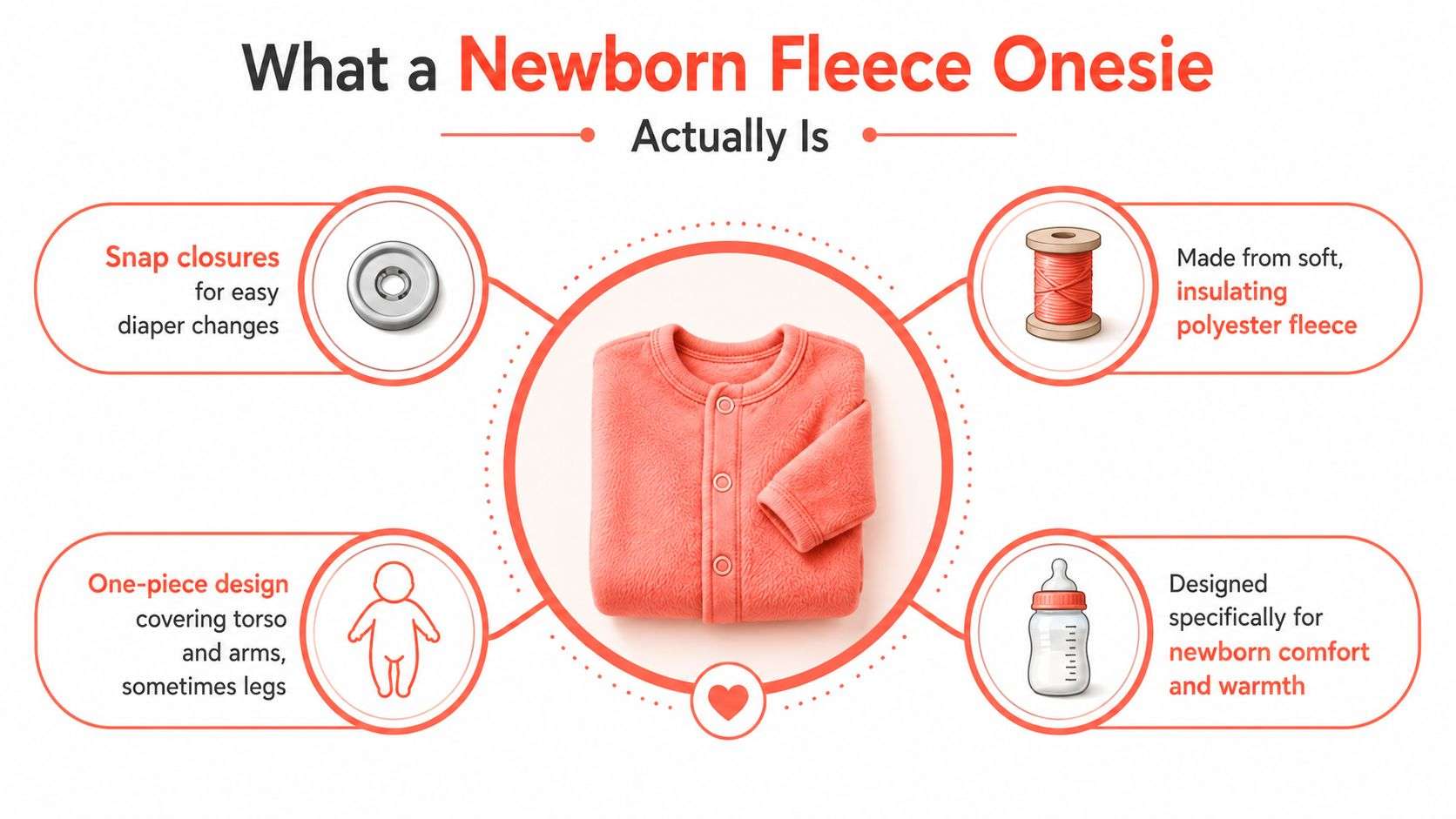
A newborn fleece onesie is a one-piece baby garment made from polyester fleece, shaped to cover the torso and arms, and sometimes the legs as well. Its main value is in how it layers, because newborn clothes need to open and close quickly without turning a nappy change into a struggle. That is why you will often see snap closures instead of a tight pullover shape.
What to look for on a product page
A good listing tells you how the garment opens, where the snaps sit, and whether the fit is regular or slim. Those details matter because fleece has less stretch than a jersey knit, so a roomier cut makes layering easier. If the neckline is too tight or the body is too short, the warmth is still there, but the garment becomes harder to use in ordinary newborn routines.
Room temperature matters just as much as the fabric tag. In a New Zealand home, the same onesie can feel sensible in a cool bedroom and too warm in a heated one, so the useful question is how much insulation the garment adds to the rest of the outfit. A fleece onesie works like a warm middle layer, almost like a soft sleeping bag with sleeves, so the parent still needs to account for the base layer and the room itself.
The broader market shows why this category stays familiar. One global report estimated the infant bodysuits and onesies market at USD 8.5 billion in 2023, with growth to USD 12.7 billion by 2032 at a 4.5% CAGR. Another estimated USD 14.5 billion in 2024, rising to USD 26.0 billion by 2032 at a 7.3% CAGR. Those are global figures, not New Zealand-only, but they help explain why onesies remain central in infant wardrobes even as families choose different fabrics for different rooms and seasons.
A fleece version sits in a narrower part of that category. It is built for warmth, not for universal everyday wear. That is why the construction matters more than the label on the tag.
How it differs from a cotton bodysuit
A cotton bodysuit is usually the everyday base layer, light, breathable, and easy to pair with other clothes. A fleece onesie is closer to a warm shell. It is the layer you reach for when the room needs more insulation, not when you want a light all-day staple.
The point is not to rank fabrics in the abstract. It is to understand the job each one does. If you can read a product listing and identify the closure, the fit, and the fabric, you are already making a better buying decision than a parent who only looks at the colour.
Fleece Compared With Cotton, Bamboo and Wool
Most parents compare fleece with the clothes they already trust, especially cotton-rich baby wear, bamboo blends, and wool. That comparison makes sense, because the key question is not whether fleece is warm, but where it fits in the layering plan. A newborn fleece onesie works best when you treat it as part of a TOG budget, the same way you would think about a sleeping bag and the blanket on top of it.
Consumer preference data helps explain why this choice feels so familiar. In infant and toddler clothing, 89% of buyers prefer clothes to be cotton-rich, while only 1% prefer general synthetics and 1% prefer polyester, according to Cotton Incorporated's Lifestyle Monitor survey What to Expect. For blankets, 75% prefer cotton-rich, while 7% prefer fleece, 3% polyester, 2% wool, and 1% synthetics.
Why that preference pattern matters
That pattern does not make fleece a poor choice. It shows fleece is usually a purpose-driven choice, not the everyday default. Parents tend to reach for it in colder rooms, during cooler stretches, or any time they need a layer that adds insulation without changing the whole outfit.
Cotton-rich garments stay at the centre of everyday dressing because they are familiar, versatile, and easier to wear for long stretches. Bamboo often comes into the conversation when softness and a lighter feel matter more. Wool sits in a similar decision space, but it usually brings a different kind of warmth, while fleece behaves more like an insulating shell than a breathable base layer.
| Fabric Preference | Infant/Toddler Clothing | Infant/Toddler Blankets |
|---|---|---|
| Cotton-rich | 89% | 75% |
| Fleece | not a leading clothing preference in the survey | 7% |
| Polyester | 1% | 3% |
| Wool | not listed as a clothing preference in the survey | 2% |
| Synthetics | 1% | 1% |
That table gives New Zealand parents a useful clue. Fleece is not the first fabric most shoppers reach for in everyday infant wear, so a fleece onesie makes the most sense when the room is cool and you want a warmer layer, not when you are building a year-round default outfit. A cotton base layer under fleece gives you more control, which matters more than the season label on the tag.
What that means in practice
If your baby spends most of the day indoors in a temperate house, cotton-rich layers usually give you more flexibility. If your home runs cool at night, fleece can sit over the base layer like a soft sleeping bag with sleeves, taking the edge off the chill without asking you to pile on too many separate pieces. For parents comparing the fleece layer with the nappy and the base layer, a practical guide to choosing a newborn diaper fit can also help keep the whole outfit comfortable.
The right choice depends less on brand and more on the job you need the garment to do. Fleece is useful when you want warmth you can add and remove in a controlled way, while cotton, bamboo, and wool each solve a different part of the dressing puzzle.
Getting the Size Right in the First Eight Weeks
Sizing causes more second-guessing than style ever will, because newborns change fast and the label can lag behind the baby. The safest approach is to ignore age as the main guide and look at current weight and length instead. That's especially true for fleece, because a snug fleece piece can feel restrictive faster than a softer, stretchier fabric.

The size ranges that matter
A typical product chart maps Newborn to 5–8 lb and 17–21 in, while 0–3M maps to 8–12 lb and 21–24 in Target sizing chart. That spread is enough to matter in the first few weeks, because a baby can move from cosy to tight very quickly.
What a good fit feels like
A regular infant fit with snap closures is easier to manage than a tighter pull-on shape, especially when you're dressing over a nappy and maybe an inner bodysuit. Snaps at the front or crotch reduce the amount of tugging around the head and shoulders, which helps when your baby is sleepy or fussy.
If you want a quick reference for changing layers around the nappy area, this guide on a newborn diaper can help you think through the base system before you add warmth on top.
If the garment leaves deep marks at the thighs, rides up at the shoulders, or makes the crotch feel crowded, it's too small for practical use.
Why the larger size can sometimes be smarter
Parents often buy the smallest size because it sounds most accurate. In reality, the slightly roomier option can be the better choice if your baby is near the top end of the weight range or you plan to layer an inner bodysuit underneath. That extra space can make night changes less stressful and lets the fleece act like a cover layer instead of a squeeze layer.
The goal isn't to leave it baggy. The goal is to keep it functional while your baby is still in that fast-changing early phase.
How Warm Fleece Really Is and When to Use It
Fleece gets described as warm, but that word is too vague to be useful at 3am. A more practical reading is that fleece sits around 3.0 TOG, which places it on the warmer end of baby sleepwear insulation Dataintelo market report. In plain terms, it behaves like a substantial layer, not a light top.
Turning TOG into dressing logic
Think of fleece as replacing about one mid-layer, and sometimes more depending on the rest of the outfit. If you already have a base layer and a warm room, adding fleece on top can be more than the baby needs. If the bedroom is cool and the house loses heat overnight, fleece can save you from stacking several thinner pieces.
That matters in New Zealand because many homes manage winter comfort with local heating, heaters in selected rooms, or layered clothing rather than uniform whole-house warmth. The garment has to work with that reality, not with an idealised nursery in a catalogue.
Best-use situations
- Cool nights: Fleece can make sense when the room feels noticeably cold and your base layer alone looks thin.
- Shoulder-season mornings: It's useful when the air is cool enough for extra insulation but not cold enough for bulky outerwear.
- Outings with light shelter: Fleece can sit under a coat or pram cover when you need warmth without too many separate pieces.
Where fleece starts to lose its place
- Warm rooms: The same insulation that feels comforting can become excessive quickly.
- Humid conditions: The garment may feel clingy or stifling.
- Too many layers underneath: Once you keep adding clothing to “make it safe,” fleece stops being efficient.
For parents who use sleep sacks, the pairing question often comes up there too. This category guide on baby sleeping bags is a useful reminder that sleepwear works best when each layer has a clear job, not when every piece tries to do everything.
Simple test: if you'd already chosen a warm sleep layer, fleece usually becomes redundant rather than helpful.
The best reading of fleece is not “winter equals fleece.” It's “cool room plus controlled layering equals fleece.”
The Overheating Question Most Guides Skip
Fleece can feel safe because it feels warm, and warm is often what exhausted parents are chasing. The problem is that synthetic fleece traps air and moisture, which can create a greenhouse effect against the skin if the room is already comfortable or if the baby has too many layers on. That doesn't make fleece unsafe by itself, it just means the garment can work against you when used automatically.
The check that beats guessing
Don't judge comfort by cold hands or feet. Use the nape of the neck instead. If the back of the neck feels sweaty or hot, the baby is likely too warm. If it feels cool and clammy, more warmth may be needed.
That check is useful because hands and feet stay cooler than the core and can mislead you into adding layers that aren't necessary. The baby's trunk tells you more than tiny fingers ever will.
What to change first
If the room warms up during the night, reduce the underlayer before you remove the fleece. If the baby already has a bodysuit plus fleece and still feels hot, the fleece should probably come off. The logic is simple, remove insulation from the core before you start making the whole outfit more complicated.
When to be extra cautious
- Overnight in a warm room: Fleece can trap too much heat.
- Under thick bedding: Extra insulation from blankets or covers can push the temperature up quickly.
- When baby is feverish or unsettled: Comfort can mask overheating, so physical checks matter more than guesswork.
Calm habit beats anxiety. You don't need to panic about fleece. You do need to treat it like an intentional layer, one that deserves a temperature check every time the room conditions change.
Washing and Drying Fleece in NZ Conditions
Care matters because fleece that pills, smells of detergent, or dries unevenly stops feeling like a useful buy. For baby clothing, a practical routine is machine wash at 30 to 40°C, skip fabric softener, and use low heat or air-drying so the shape and surface hold up. Retail guidance for fleece onesies commonly points to polyester-rich construction and gentle wash care, which fits the kind of routine newborn clothes need John Lewis fleece onesie care example.
Why laundry choice matters more in cool weather
New Zealand homes that rely on line drying can leave fleece hanging longer in cool or humid conditions. The fabric still dries reasonably well, but the slower drying environment can make residue and odour more noticeable if you overload the wash or use scented products. For sensitive newborn skin, that's not a small detail.
If your baby seems irritated by freshly washed clothes, the first things to rethink are the detergent and the rinse. A fragrance-free wash routine is often the least fussy option, and an extra rinse helps when the fabric feels like it's holding onto soap.
A simple care routine
- Wash gently: Use a 30 to 40°C cycle rather than a hot wash.
- Leave out softener: It can interfere with fleece texture.
- Dry carefully: Low heat or shade-drying protects the fabric surface.
- Store folded: Compression in a crowded drawer can encourage pilling.
What to expect from the fabric
Fleece can be practical if you want something that dries faster than heavier natural fibres. It can also be less forgiving if you treat it like ordinary laundry. The more often it's washed with harsh products, the sooner it loses the soft feel that made you buy it in the first place.
The bottom line is plain. In cool, damp conditions, fleece can still work well, but it rewards a gentle laundry routine more than a rough one.
Your Newborn Fleece Onesie Buying Checklist
A good buying decision starts with three questions, not one. First, does your baby need more warmth in the rooms where they sleep and rest? Second, can the garment fit current weight and length without squeezing the shoulders or crotch? Third, will your laundry routine support the fabric without making it rough or irritating?
A quick decision framework
- Check body size first: Use weight and length, not age alone, because newborns move through size ranges quickly.
- Match the room: If your home runs cool at night, fleece may earn its place. If the room stays mild, cotton-rich layers usually make more sense.
- Plan the underlayer: Fleece should sit in a system, not act as the only answer.
- Look at closure style: Snaps make practical sense for changes and layering.
- Think about washing: If you can't wash gently and dry it well, the garment won't stay pleasant for long.
If you're comparing baby basics more broadly, the newborn baby clothes category is a useful place to think about how fleece fits beside everyday cotton pieces, rather than treating it as a stand-alone answer.
A fleece onesie is usually the right call when you want controlled warmth, not maximum bulk. It's usually the wrong call when the room is already warm, when you're layering too aggressively, or when your baby's skin does better with lighter fabrics. That's why the best purchasing habit is to start with the environment, then choose the garment.
NappyCare.Store carries baby essentials that sit in the same practical space as this guide, including newborn sleep and care items, so if you're still building a small winter wardrobe, visit NappyCare.Store and choose the pieces that fit your baby's room, your laundry routine, and your night-time changing habits.
Crafted with the Outrank app