

Packing for a winter baby often starts the same way. You’ve folded tiny singlets, maybe a swaddle or two, and then you stop at the question every New Zealand parent asks when the temperature drops, do we need something warmer for the nights home from hospital and the first damp mornings? A newborn fleece onesie can fit that gap, but only if you treat it as a layer with a job, not as a blanket answer for every hour of the day.
The confusion usually comes from mixing up warmth with safety. Fleece can be a smart choice when the room is cool, the baby needs an outer layer, or the weather is firmly in winter mode. It’s less useful when parents assume thicker automatically means better for sleep, because babies don’t need to be swaddled in heat to stay comfortable.
Table of Contents
- Why Newborn Fleece Onesies Earn a Spot in the Layette
- Understanding Fleece Fabrics, Weight, and Warmth Ratings
- Getting the Size Right for a Newborn
- Matching Fleece Weight to NZ Seasons and Climates
- Safe Layering and Sleep Use for Newborns
- Washing and Caring for Fleece Without Ruining It
- A Practical Buying Checklist Before You Checkout
- Common Questions Parents Ask After Buying
Why Newborn Fleece Onesies Earn a Spot in the Layette
You usually meet the newborn fleece onesie at a very practical moment, not a stylish one. The hospital bag is half-packed, the baby room feels cold at night, and you’re trying to decide whether the first few weeks will be all cotton or whether one warm all-in-one belongs in the drawer too.

A fleece onesie is a one-piece garment with a brushed, insulating surface, often designed with front snaps or a full opening for easy nappy changes. In a layette, it plays a different role from cotton bodysuits. Cotton sits closer to the skin as the everyday base, while fleece comes in when warmth matters more than breathability.
Why New Zealand parents reach for it
The New Zealand climate makes this choice feel very real. Autumn evenings, wet winter mornings, and chilly bedrooms push parents toward something warmer, especially when the baby is too small to regulate temperature well on their own. That’s where fleece earns its place, not as a default outfit, but as a seasonal thermal layer.
Cotton Incorporated’s consumer survey helps explain the fabric hierarchy parents often follow. Among infant and toddler blankets, 75% of shoppers wanted cotton-rich materials, while fleece was preferred by only 7% of consumers, and 89% of infant and toddler-product buyers preferred cotton-rich clothing overall (Cotton Incorporated). That preference pattern matters for fleece onesies because it shows fleece usually fills a narrower, function-led role.
Practical rule: if you’d choose a cotton bodysuit for an ordinary day, choose fleece only when you need a warmer layer for a specific cold-weather job.
The broader infant bodysuit category is also large and still expanding, with market estimates placing it at USD 8.5 billion in 2023 and projecting it to reach USD 12.7 billion by 2032 at a 4.5% CAGR, while another forecast estimated USD 14.5 billion in 2024 rising to USD 26.0 billion by 2032 at 7.3% CAGR (Dataintelo). That tells you fleece onesies aren’t a niche afterthought, they sit inside a steady essentials market.
Understanding Fleece Fabrics, Weight, and Warmth Ratings
Fleece works a bit like a tiny blanket built into clothing. Its brushed fibres trap air, and trapped air is what holds warmth close to the body. That’s why a fleece onesie can feel cosy fast, while a cotton jersey layer feels lighter and more breathable.

The label clues that matter most are fabric weight and TOG. In NZ and AU retailer data, fleece onesies commonly come in 100% polyester or wool-blend constructions such as 68% merino wool, 29% Tencel, and 3% spandex at 270 gsm with 18.5-micron wool fibre diameter (The Sleep Store). In thermal terms, fleece is often treated as roughly 3.0 TOG, which makes it much warmer than standard cotton jersey and more suitable for cool rooms or winter layering.
The two constructions parents usually see
| Fabric Type | Typical Weight | Warmth | Best For |
|---|---|---|---|
| Polyester fleece | Light to medium loft, varies by garment | Warm, fast-drying, high insulation | Cold snaps, quick washing, outer layers |
| Merino/Tencel fleece blend | Often around 270 gsm in NZ/AU listings | Warm, with better moisture management and a softer hand-feel | Babies with sensitive skin, winter layering, regular wear |
Polyester fleece maximises loft and tends to dry faster after washing. Merino/Tencel blends add moisture management and a finer feel against the skin, which matters if your baby’s skin runs sensitive or you wash often. The right choice depends less on the word “fleece” and more on how the fabric behaves after heat, moisture, and laundry.
If the garment feels lofty in your hands, it’s usually acting like insulation. If it feels flat and compact, it won’t hold as much warmth.
The cause and effect are simple. More loft means more trapped air, which means more insulation. It also means more caution is needed in warm bedrooms, because the same structure that holds warmth can also hold too much heat.
Getting the Size Right for a Newborn
A fleece onesie only fits well when it matches the baby’s body shape, not just the age on the label. Too tight, and it squeezes the loft that helps fleece hold warmth. Too loose, and the fabric bunches at the neck, sleeves, or legs, which can make a baby fussy and leave gaps where warmth escapes.

Published infant size charts show newborn and 0–3 month garments are commonly graded around 17–24 in body height coverage or about 36–43 cm length, with chest widths around 20–22.5 cm for newborn and 3–6 month sizing in regional tables (Petit Bateau). That is why age labels can mislead. A baby can be small in one measurement and long in another, and fleece does not stretch and recover in the same forgiving way as a soft knit cotton.
What to check before you buy
- Measure length, not just age: a baby who is tall for their age may need the next size sooner than the label suggests.
- Look at chest room: the onesie should skim the body, not squeeze it.
- Check snap placement: front snaps or a full opening make nappy changes easier without stripping the baby back down.
- Feel the cuffs: close-fit cuffs help reduce heat loss, but they shouldn’t leave marks.
Fit also affects how the garment behaves after laundry, because a fleece piece that starts out snug may feel more restrictive once it has been washed and dried a few times. For that reason, it helps to read the care label before you buy, then compare it with the garment’s shape and seam layout rather than relying on size alone.
For nappy practicality, a close-fitting fleece onesie is easier to manage when the crotch opening or snap layout supports frequent changes without a full outfit removal. If you are sorting the rest of the change kit too, this newborn diaper guide can help you think through the basics.
Matching Fleece Weight to NZ Seasons and Climates
A fleece onesie that feels perfect in Dunedin can be far too warm in an Auckland lounge. New Zealand isn’t one climate, so the garment needs to match the room and the region, not just the month on the calendar.
Mild, damp, and frosty are not the same thing
In a mild Auckland winter night, a lighter fleece can work as an outer layer over a cotton bodysuit, especially if the home is already reasonably warm. In a damp Wellington morning, the issue is often chill plus moisture, so parents may prefer a mid-weight fleece for wake time, then swap back to breathable layers once the baby settles inside. On a South Island frost, a thicker fleece or a merino-rich blend makes more sense for short outdoor transitions and cool rooms.
That’s the key point. “Fleece for winter” is too vague to be useful.
Best mental model: think of fleece as a weather tool, not a permanent uniform.
Transitional seasons need even more judgement. A lighter fleece can be enough in autumn if the baby is only moving between a cot, a pram, and a warm lounge. A thick all-in-one becomes less sensible when the room is already heated and the baby just needs a small thermal boost instead of full insulation.
The weight of the fabric matters because more loft usually means more heat retention. That’s helpful when the air is cold and the baby’s core temperature needs support, but it becomes less helpful when the same garment sits under a blanket or in a warm room. In plain terms, the colder and less stable the environment, the more fleece earns its keep.
One useful way to decide is to start with the room, then choose the garment. If the nursery feels brisk and the baby is awake, fleece may be the right outer layer. If the room is already comfortably warm, cotton often does the job with less risk of overheating.
Safe Layering and Sleep Use for Newborns
The biggest mistake parents make with fleece is assuming thicker equals safer. For newborn sleep, that isn’t true. Fleece does not breathe as well as cotton, and it can trap moisture, which means the baby can feel warm on the outside while still building heat underneath.
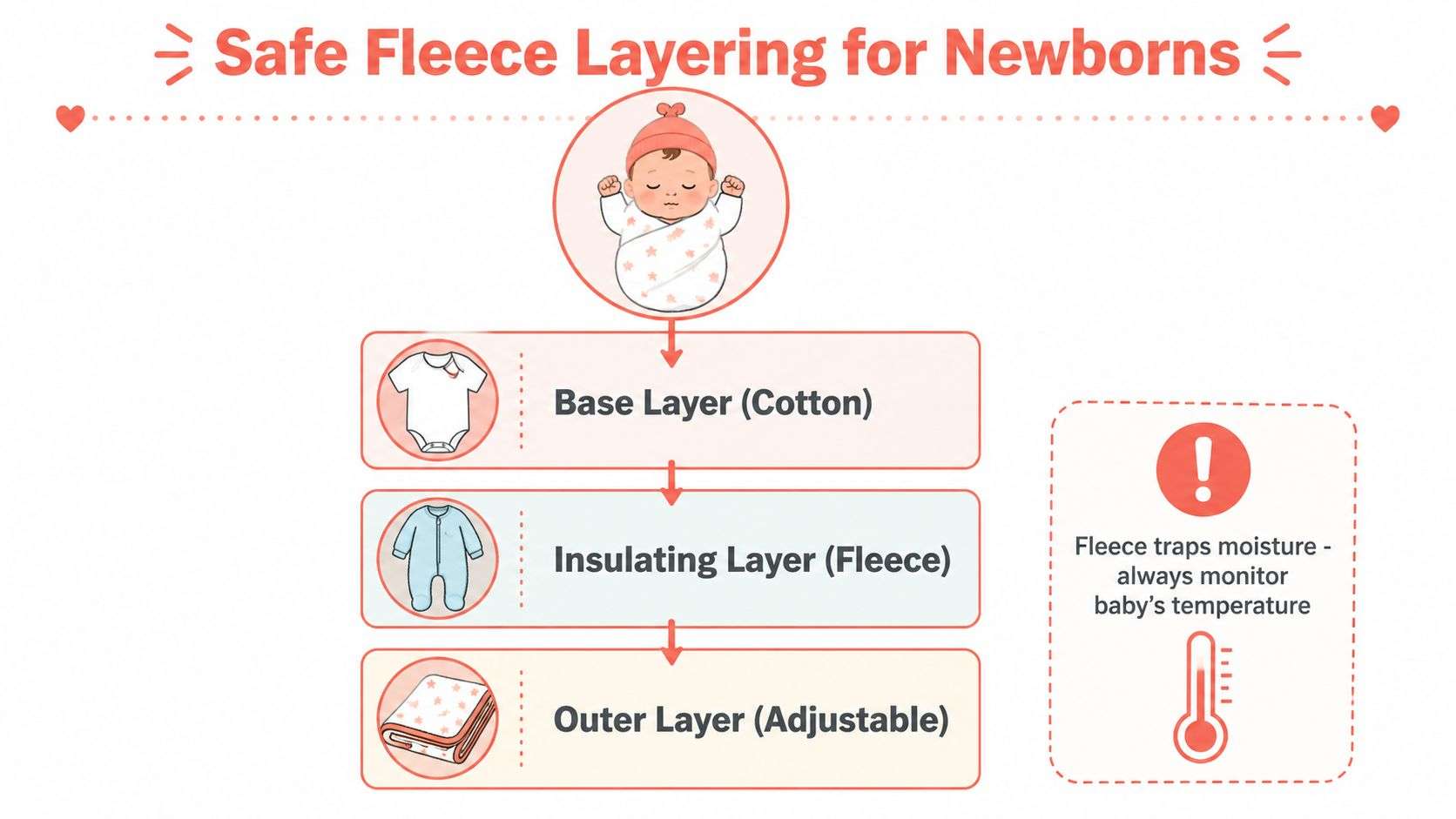
Independent baby sleep guidance emphasises breathable layers and careful temperature monitoring, while cold-weather parenting advice warns that fleece doesn’t breathe well and can trap moisture, which raises overheating concerns at night (Woolino). That matters in NZ because winter air can tempt parents into over-layering, especially in older houses that run cool overnight.
A simple way to think about sleep layering
Start with a cotton base layer. Add fleece only when the room is cool enough to justify the extra insulation. Then monitor the baby, because the whole point of layering is flexibility, not piling on fabric and hoping for the best.
A good check is the baby’s chest and neck. Flushed cheeks, a damp neck, or a sweaty back tell you the outfit is holding too much heat. If the baby feels warm but clammy, the layer stack is doing too much.
The safest use case for fleece is often awake wear, short naps, or cool-room sleep when the overall outfit makes sense. It can also work as part of a controlled stack, but only when the room temperature and the rest of the sleepwear support it. In other words, fleece is a tool for managing cold, not a universal sleep fix.
The video below is useful if you want a visual reminder of how layering should stay adjustable rather than bulky.
If you’re choosing sleepwear alongside the rest of the nursery setup, it can help to think in layers and not in one-piece “solutions.” A baby sleeping bag range may suit some sleep setups better than a fleece outfit alone, depending on how warm the room runs.
Washing and Caring for Fleece Without Ruining It
A newborn fleece onesie can feel cosy in the drawer, then lose much of that softness if the wash routine is too harsh. Fleece depends on tiny brushed fibres holding air, a bit like the loft in a winter quilt. If those fibres get flattened by strong detergent, fabric softener, or hot drying, the garment still looks fine at a glance but stops trapping warmth properly.
A care routine that protects both skin and fabric
Use a gentle, fragrance-free detergent and wash at 30°C to 40°C when the care label allows it. That temperature range is commonly used for baby fleece care because it cleans well without stressing the fabric. Skip fabric softener. It can coat the fibres, and that coating works against both softness and absorbency.
- Wash new garments before first wear: this helps remove loose dye residue and any finish that might bother sensitive skin.
- Choose gentle detergent: stronger isn’t better for baby wear.
- Air dry when possible: heat from tumble drying can flatten the brushed pile and shorten the life of the garment.
- Check the seams and cuffs after washing: if the fleece starts pilling heavily or feeling flat, it’s losing performance.
Skin sensitivity matters here as well. Guidance on baby fleece care recommends gentle laundering and avoiding harsh additives, especially for babies prone to irritation (Momcozy). Fleece can also hold wetness against the skin once it is saturated, so a clean, well-rinsed garment matters more than many parents expect.
A fleece onesie should come out of the wash soft, not stiff. If it feels crunchy, over-scented, or rough, the laundry routine needs changing.
Retire a fleece onesie when the pile is badly flattened, the fabric pills heavily, or the cuffs no longer sit neatly. At that point, it may still be wearable, but it will not be doing the insulation job you bought it for.
For parents comparing fleece with other baby clothing, baby clothes by category can help sort the options without guessing which item suits the season.
A Practical Buying Checklist Before You Checkout
The easiest way to buy fleece well is to ask five short questions before you click through. If the garment answers them cleanly, you’re probably looking at a sensible cold-weather piece. If it doesn’t, keep browsing.
The five checks that matter most
-
What is the fabric?
Look for either polyester fleece or a merino/Tencel-style blend. Polyester usually gives more loft and faster drying, while blends can feel gentler on the skin. -
Does the fit match the baby, not the age label?
Check body length and chest room against the sizing chart. A newborn who is long for their age may need a larger size sooner. -
Does it suit your room temperature and season?
Use lighter fleece for milder cold, thicker or blended fleece for colder conditions, and avoid treating fleece as a one-size-fits-all sleep layer. -
Is the opening practical for nappy changes?
Front snaps or a full opening save time and reduce outfit disruption. -
Will you wash it gently enough to keep it soft?
If your routine depends on harsh detergent or high heat drying, fleece won’t hold up as well.
For parents browsing broader baby apparel, the fleece onesie sits inside a category that remains stable and well stocked, not a passing fashion idea. If you’re comparing options in one place, baby clothes by category can help you sort through different garment types without guessing from photos alone.
NappyCare.Store also sits in this kind of practical shopping space. Its range covers baby and maternity essentials, so it can be one place parents check when they’re assembling winter basics, sleep items, and everyday infant gear.
Common Questions Parents Ask After Buying
Is a fleece onesie safe for eczema-prone skin?
It can be, but the construction matters. Softer blends, gentle laundering, and avoiding harsh detergent are more important for sensitive skin than the word “fleece” alone. If the baby’s skin reacts easily, choose the smoother-feeling option and watch for redness after wear.
How many fleece onesies does a newborn need?
Most parents don’t need many. One or two usually cover the cold-weather rotation if the garment is washed regularly and used as a layer, not an everyday default. A small number also makes sense because babies outgrow sizes quickly.
When should I size up?
Size up when the onesie starts compressing across the chest, pulling at the crotch, or bunching so much that the cuffs sit awkwardly. The baby’s actual length matters more than the label, especially with fleece, because a snug fit changes how the fabric insulates.
Can it double as sleepwear for travel or in the car?
Only when the temperature and layer stack make it sensible. For short travel, a fleece onesie can work as a warm layer, but you still need to think about heat build-up and remove it if the baby feels warm or damp. Car seats add another layer of judgement, because bulky clothing can change how snugly the harness sits.
If you’re comparing winter baby layers right now, visit NappyCare.Store to look through newborn essentials, sleep items, and practical infant accessories in one place. It’s an easy way to match a fleece onesie with the rest of your baby’s cold-weather routine, instead of guessing one piece at a time.
Produced via the Outrank app